
Going Viral Is Not the Same as Lasting: What Olaplex's Fall From $19 Billion Can Teach You
Situation
I have a teenage daughter, which means I have a front row seat to the way beauty products go viral now. A serum or a hair treatment shows up in her feed, a creator she trusts calls it a must-have, and within a week it is the only thing she wants. She is not reading ingredient lists or clinical studies. She is responding to the same wave of content everyone her age is responding to, the kind that can turn a single product into the thing the whole internet suddenly needs. Watching it up close, I keep thinking about how powerful that engine is, and how fragile a business can be when it is built on top of it.
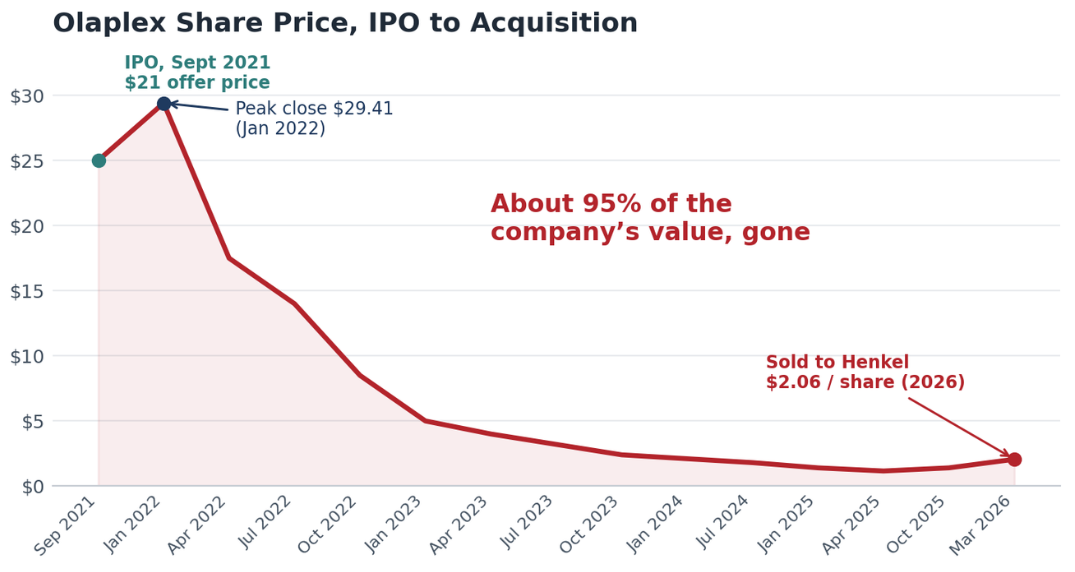
Olaplex is what happens when that engine builds a company and then turns on it. The brand started with a real innovation. Its bond-building chemistry came out of the salon, where stylists used it to protect hair through color treatments, and in 2015 the company brought that same technology home with No.3 Hair Perfector. The growth that followed was the kind founders dream about. Net sales climbed from $148 million in 2019 to nearly $600 million by 2021. The company went public in September 2021 at around $25 a share, and by January 2022 the market valued it at roughly $19 billion. Its margins were extraordinary, the kind of numbers that make investors lean forward in their chairs.
Then the floor gave way. In March 2026, Olaplex agreed to be acquired by the German consumer giant Henkel for $1.4 billion in cash, about $2.06 a share. The stock had lost close to 95 percent of its value since the IPO and had touched a low near a dollar. Annual revenue had fallen to roughly $423 million in 2025, down from a peak of $704 million three years earlier. The deal was a 55 percent premium over where the stock had been trading the day before, which tells you how far it had already fallen.
A company worth $19 billion sold for $1.4 billion. That is not a rounding error. That is a business that looked invincible and turned out to be hollow underneath. The question worth sitting with is not what went wrong at the end. It is what decision, made years earlier and while everything still looked great, set the ending in motion.
I will be honest with you. I am watching the early chapters of this same story play out right now in real, healthy businesses, the kind that look nothing like a cautionary tale yet. This is a very relevant story to business owners exclusively reliant on social media.
Insight
Here is what Olaplex was actually deciding, long before the sale, and it happened while the company still looked like a genius.
The credibility that built the brand came from one place: the salon. Stylists trusted the science and recommended it to clients, and that kind of endorsement is worth more than any ad because it has to be earned. But the fastest, most visible growth came from celebrity and influencer marketing, so that is where the company poured its money. In effect, Olaplex spent its most valuable asset, the hard-won trust of professionals, to buy something cheaper and louder: viral reach. Here is the part that catches people off guard. Those two kinds of trust behave in opposite ways. Borrowed trust scales fast and vanishes fast. Owned trust builds slowly and holds when you are under pressure. Olaplex leaned its entire valuation on the kind that vanishes.
Now look at the number everyone was celebrating, because this is the part that should change how you read your own. Olaplex had one of the most beautiful gross margins in all of consumer goods. Gross profit is simply what is left after you subtract what it actually costs to make and deliver the product or service, and Olaplex kept around 70 cents of every dollar, while generating close to $6 million in revenue for every employee on its payroll. Every founder is taught to want numbers like that. But a gross margin that high, in a category anyone can copy, is rarely a sign of strength. It usually means a company is harvesting a temporary monopoly and reinvesting almost nothing in defending it. The margin was not only a result of the brand. It was the warning. And here is the part that stings: the money Olaplex needed to protect itself was sitting right there inside that margin, and the company let it flow to the bottom line and the IPO story instead of spending it on a moat.
A CFO looking at that 70 percent would have spent some of it down on purpose:
Lean into the salon channel. It carries a lower margin because you sell at a wholesale discount, but its loyalty does not evaporate the moment sentiment turns.
Broaden the product line. More products cost more to make and pull the margin down further, so a single viral scare cannot take the whole company down with it.
Fund the unglamorous defenses below the margin line. Rigorous clinical testing, a repeat-purchase base, and salon education. When the hair-loss claim hit in 2023, that is the difference between published data ending it in days and a story left to spread on TikTok for months.
Every one of those moves would have made the headline numbers look worse in the exact years everyone was praising them. A healthier Olaplex would have reported a gross margin in the low 60s instead of the low 70s, and that lower number would have been the real sign of strength.
So why does this matter for women building their own businesses? Because the number you are proudest of might be the one hiding your biggest risk. A high margin on an offer anyone can copy, sold to demand you do not own, often just means you have not yet been forced to spend it defending yourself. The question that actually predicts whether you last is this: what would happen to that margin if your loudest channel went quiet tomorrow, and what are you doing now, while times are good, to make sure the answer is survivable?

Application
Protect your loyal revenue, even when it earns a little less. The highest-margin work is often the most fragile: the one-off project, the hype-driven launch, the single big client. The retainer clients, repeat work, and referral partners who recommend you on results may earn you less per hour after everything you put in, but they are the floor that holds when a launch flops or a market cools. Olaplex starved its most loyal channel because it earned less. Do the opposite.
Spend some of your margin building defensibility before you need it. Documented results and case studies, a real retention system, deeper client relationships, your reputation. These cost you margin or time today and they look like overhead. They are also the published proof that kills a bad story fast and the repeat revenue that keeps you steady while sentiment recovers. The best time to buy that insurance is the year you feel certain you will never need it.
Treat an unusually high margin as a question, not a trophy. If a part of your business is throwing off a fat margin and you cannot name what stops a competitor from copying it, you are probably harvesting rather than building. Ask what that margin is failing to fund. A number that high often means money is leaving the business as profit when it should be going back in as a moat.
A note especially for women founders. The pull toward the impressive number is real. The premium margin, the high-end offer, the figure you can say out loud, all of it feels like proof you are winning, and a lower margin can feel like falling behind. But running a leaner margin on purpose, because you are pouring the difference into the things that make your business hard to copy and hard to shake, is one of the most sophisticated moves a founder can make. Choosing durability over the dazzling number is not playing small. It is the most strategic decision on the table.
Takeaway
Olaplex is not a story about a bad product. The chemistry was real, and the early growth was earned. It is a story about what happens when a company lets the growth narrative make its decisions instead of the thing that made it trustworthy in the first place.
Henkel, the consumer goods company buying it, may well steady the brand, and there is a real business still there to rebuild. But a $19 billion company does not fall to $1.4 billion because of one lawsuit or one competitor. It fell because the foundation was thinner than the valuation suggested, and almost no one noticed while the numbers were still going up.
"The margin everyone envied was the very money Olaplex needed to defend itself. It chose the applause instead."
Sources & References
CNBC, "Olaplex to be acquired by German company Henkel in $1.4 billion deal," March 26, 2026: https://www.cnbc.com/2026/03/26/olaplex-acquired-henkel.html
Retail Dive, "Olaplex to be acquired by Germany's Henkel for $1.4B": https://www.retaildive.com/news/olaplex-acquired-henkel-one-billion/816803/
BeautyMatter, "Henkel Acquires Olaplex: Can It Restore the Brand's Core Identity?": https://beautymatter.com/articles/olaplexs-ipo-undoing-and-henkels-second-chance-at-a-turnaround
Business of Fashion, "Olaplex Embarks on Turnaround Plan After Rough 2023": https://www.businessoffashion.com/news/beauty/olaplex-embarks-on-turnaround-plan-after-rough-2023/
NPR, "Women claim in a lawsuit they lost hair after using Olaplex products regularly," Feb. 16, 2023: https://www.npr.org/2023/02/16/1157398619/olaplex-lawsuit-hair-loss
StockAnalysis, Olaplex Holdings (OLPX) Revenue 2020-2026: https://stockanalysis.com/stocks/olpx/revenue/